Google's SynthID AI watermarking tech is being adopted by OpenAI, Nvidia, and more
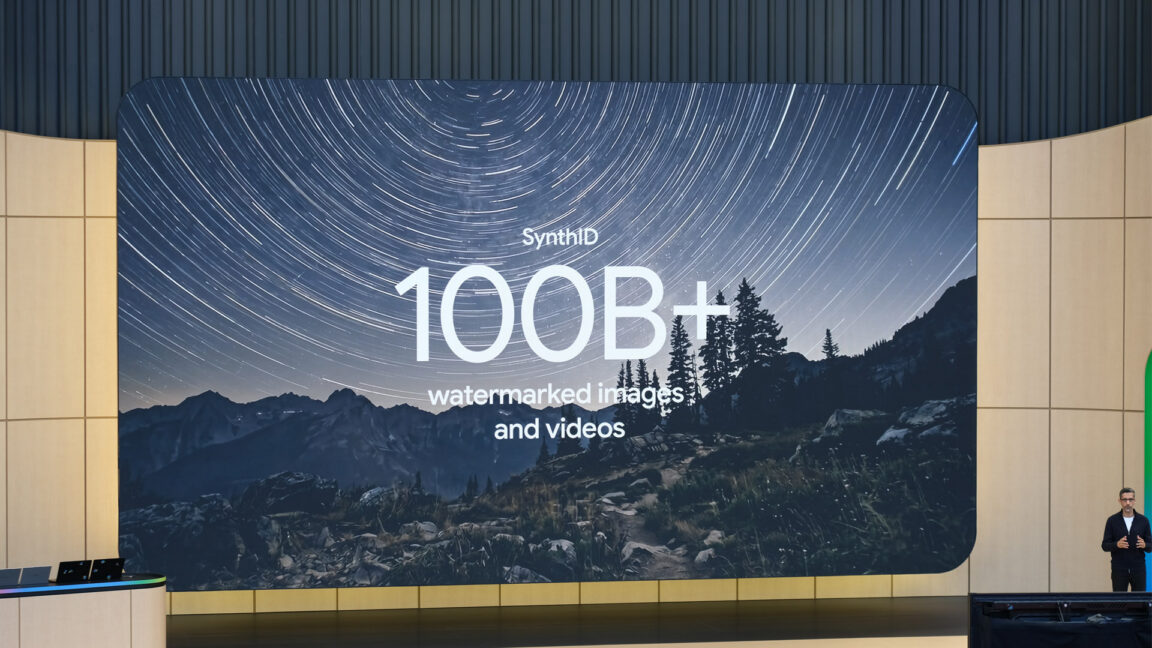
Google's SynthID, a digital watermarking technology for AI-generated content, is expanding its reach beyond Google. Major players like OpenAI and Nvidia are adopting SynthID to label their AI models' output, increasing transparency in distinguishing AI-created media from authentic content. This initiative aims to combat the proliferation of realistic AI-generated images, videos, and audio, making it harder to remove embedded watermarks and offering improved detection methods across various platforms.
In an era where AI-generated content can be indistinguishable from reality, Google’s SynthID offers a solution. This digital watermarking technology, first demonstrated three years ago, has already been used to label billions of images and videos and thousands of years' worth of audio. Now, SynthID is expanding its reach beyond Google. Google aims to increase transparency and help users identify AI-generated media.
SynthID works by embedding an imperceptible digital watermark directly into the pixels of images and videos, and the waveform of audio. This makes the watermark significantly more robust and difficult to remove, even when content is compressed, cropped, or rotated. This resilience is a key differentiator from metadata-based labeling, which can be easily altered.
Major AI players are now adopting SynthID. Nvidia will integrate the technology into its Cosmos world foundation models, while OpenAI will use it for its GPT 2 images. Kakao and ElevenLabs are also incorporating SynthID into their AI content generation. This widespread adoption marks a significant step towards a more transparent digital landscape.
Google is also enhancing its own platforms with SynthID detection. The Gemini app already allows users to upload suspect content and check for AI generation. Upcoming updates will bring C2PA scanning to Gemini, Chrome, and Search, enabling these platforms to explain content provenance based on embedded labeling. This offers multiple avenues for users to verify the authenticity of digital media.
While SynthID is a strong step forward, it's important to note its current limitations. Only content generated by AI models that have integrated SynthID will carry the watermark. Many publicly available and open-source AI models currently do not include such watermarking. However, the expansion to partners like OpenAI and Nvidia will significantly increase the volume of watermarked AI content.
Google is also preparing to launch an AI content detection API as part of its Gemini Enterprise Agent Platform. This will enable trusted business partners to easily flag AI content, further refining the detection capabilities and contributing to a more reliable system for identifying AI-generated media.
Related articles
Build real agentic apps using CUGA: two dozen working examples on a lightweight harness
CUGA, IBM's open-source Agent Harness, simplifies building agentic applications by handling infrastructure, allowing developers to focus on tools and prompts. It offers pre-assembled components for planning, execution, and state management, significantly reducing development time. CUGA has topped agent benchmarks like AppWorld and WebArena.
OpenAI launches new initiative to help find and patch open source bugs
OpenAI has launched "Patch the Planet," a new initiative in partnership with cybersecurity firm Trail of Bits, to enhance the security of open-source projects. This program aims to assist maintainers in identifying and patching bugs, utilizing OpenAI's AI-powered security tools while reducing the burden on project teams.
PP-OCRv6 on Hugging Face: 50-Language OCR from 1.5M to 34.5M Parameters
Baidu has released PP-OCRv6, an advanced optical character recognition (OCR) model supporting 50 languages. Available on Hugging Face, this version significantly improves accuracy and efficiency across various parameter sizes, from 1.5 million to 34.5 million, marking a substantial leap in multilingual OCR technology.