How CopilotKit Is Redefining the Agentic AI Stack in 2026
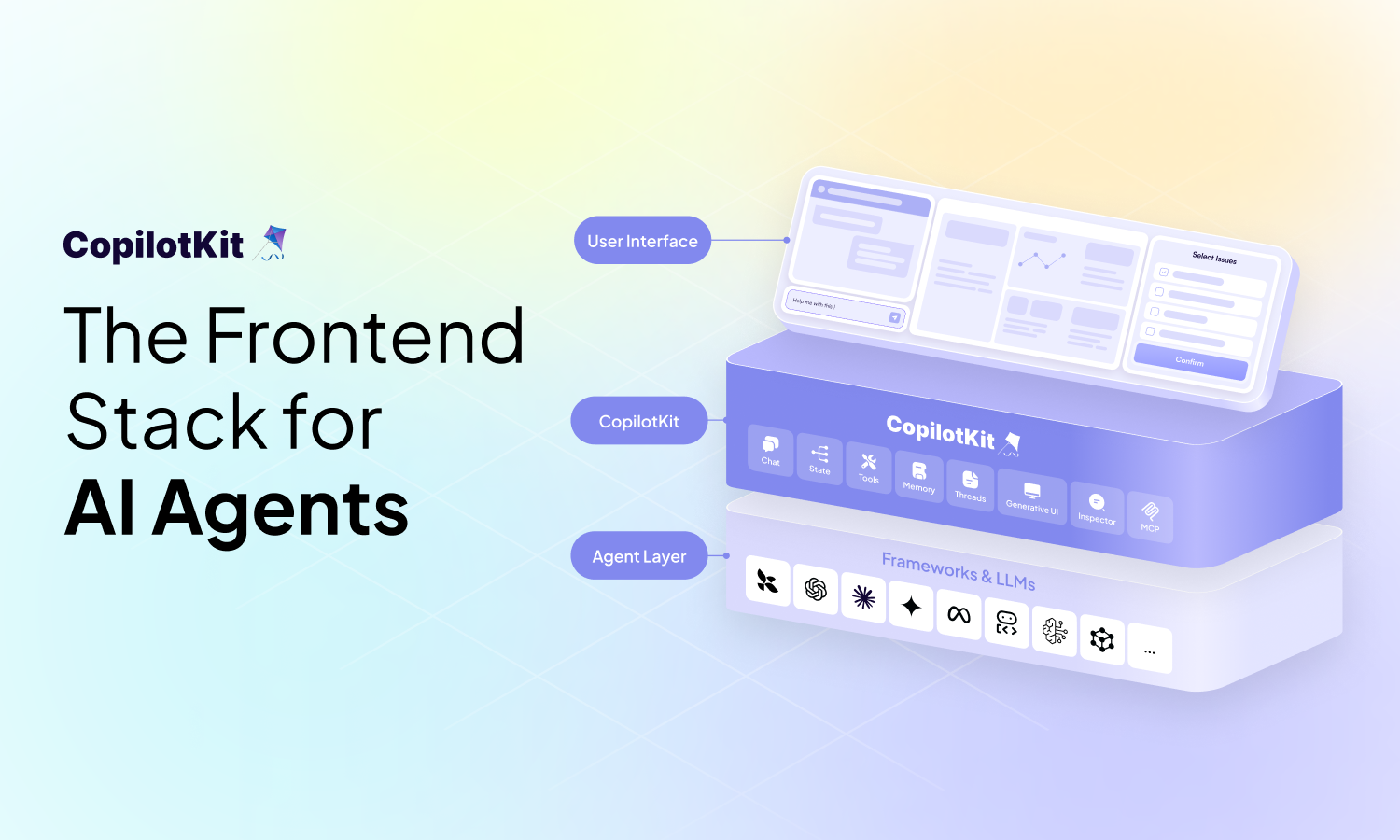
CopilotKit has revolutionized AI interaction within applications by introducing AG-UI, a protocol that enables agents to understand user actions, take initiative, and provide dynamic interfaces. This innovation, alongside tools for robust testing and knowledge retrieval, is transforming how AI agents are integrated into production systems. This approach addresses long-standing challenges in agent deployment, moving beyond simple chat functionalities to create truly interactive and reliable AI experiences.
For years, AI in software was limited to basic chat widgets, requiring users to manually interpret textual responses. CopilotKit observed this limitation, recognizing that the model was fundamentally broken. By 2026, the developer community widely agreed with this assessment. Their solution involves enabling AI agents to operate within applications, understand user actions, and provide dynamic, interactive interfaces rather than just blocks of text. This approach aims to bridge the gap between agent demos and production-grade systems by addressing crucial infrastructure challenges.
The agentic ecosystem is built on a three-layer stack: MCP for external tool access, A2A for agent coordination, and AG-UI for human-agent interaction within applications. AG-UI, developed by CopilotKit, specifically addresses the critical boundary where users engage with agents, ensuring transparency, safety, and control. It facilitates real-time streaming, dynamic UI generation, bidirectional state synchronization, and human-in-the-loop pauses for user confirmation.
Major AI infrastructure providers and frameworks widely support this protocol, and its ecosystem extends to numerous programming languages and educational courses. This widespread adoption, including integration into AWS services and academic curricula, signifies its maturity as a production infrastructure rather than just an experimental standard.
To ensure the reliability of these complex agentic systems, CopilotKit introduced AIMock in April 2026. This tool addresses the critical issue of inadequate agentic testing, where most test suites fail to account for the numerous non-deterministic services an agent interacts with. AIMock allows developers to simulate all dependencies through a single JSON configuration, offering record-and-replay functionality, drift detection for schema changes, and chaos testing to build resilient applications. The "Pathfinder" tool, the third advancement in CopilotKit's 2026 cycle, focuses on knowledge retrieval for agents. It's a self-hosted MCP server that indexes diverse documentation and communication sources—such as code, Notion pages, Slack threads, and Discord forums—making them searchable and accessible to AI coding agents. This ensures agents can find accurate, current information, resolving a common blocker for production deployments. CopilotKit's tools, along with the AG-UI protocol, represent a significant leap forward in creating reliable, interactive, and intelligent agentic AI systems.
Related articles
Build real agentic apps using CUGA: two dozen working examples on a lightweight harness
CUGA, IBM's open-source Agent Harness, simplifies building agentic applications by handling infrastructure, allowing developers to focus on tools and prompts. It offers pre-assembled components for planning, execution, and state management, significantly reducing development time. CUGA has topped agent benchmarks like AppWorld and WebArena.
OpenAI launches new initiative to help find and patch open source bugs
OpenAI has launched "Patch the Planet," a new initiative in partnership with cybersecurity firm Trail of Bits, to enhance the security of open-source projects. This program aims to assist maintainers in identifying and patching bugs, utilizing OpenAI's AI-powered security tools while reducing the burden on project teams.
PP-OCRv6 on Hugging Face: 50-Language OCR from 1.5M to 34.5M Parameters
Baidu has released PP-OCRv6, an advanced optical character recognition (OCR) model supporting 50 languages. Available on Hugging Face, this version significantly improves accuracy and efficiency across various parameter sizes, from 1.5 million to 34.5 million, marking a substantial leap in multilingual OCR technology.