
The Internet can't stop watching Figure AI's humanoid robots handling packages
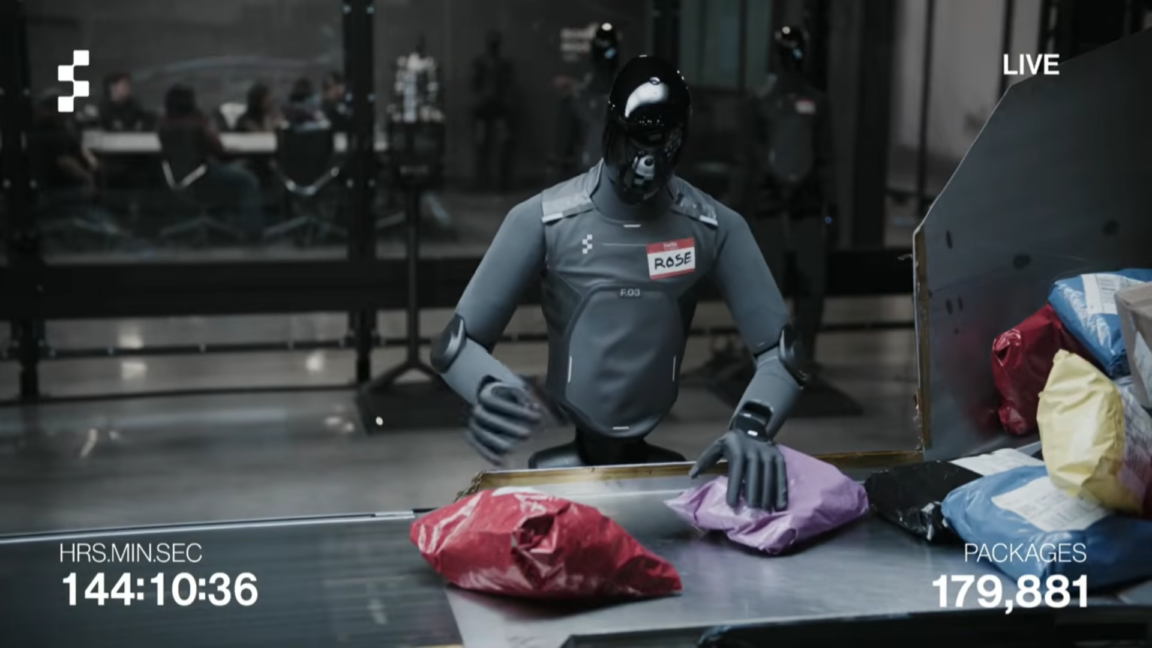
Figure AI's humanoid robots captivated viewers worldwide with a viral livestream showcasing their package-handling abilities, drawing comparisons to iconic product demos. Despite initial skepticism and minor setbacks, the robots demonstrated impressive endurance and autonomy, sparking both enthusiasm and debate about their true capabilities. The event culminated in a "Man vs. Machine" challenge, where a human intern narrowly outperformed the robots.
Figure AI, a robotics startup, recently gained significant attention with a viral livestream featuring its humanoid robots sorting and placing thousands of packages onto a conveyor belt. The demonstration, which ran for nearly a week, showcased the company's latest Figure 03 robots performing this task autonomously. The event quickly became a sensation among tech enthusiasts, with social media users praising the robots' performance.
The robots operate using Figure AI's Helix 02 neural network system, which enables full-body control and "long horizon autonomy." This system, trained on over 1,000 hours of human motion data and extensive simulations, allows the robots to perform tasks independently, with on-device AI inference. The robots are also networked, enabling them to autonomously request recharging or address hardware issues by swapping out with another unit.
Initially, Figure AI CEO Brett Adcock set low expectations, anticipating breakdowns during the planned eight-hour demonstration. However, the robots surpassed expectations, eventually running for over 48 hours nonstop. This endurance test generated considerable excitement, culminating in a "Man vs. Machine" competition where an intern, Aimé Gérard, competed against the robots in package sorting.
While the intern ultimately won by a narrow margin, sorting 12,924 packages compared to the robots' 12,732, the robots demonstrated remarkable efficiency, averaging 2.83 seconds per package. Adcock, though acknowledging the human victory, predicted this would be the last time a human would win such a challenge.
Despite the positive reception, some viewers raised questions about the robots' occasional mishandling of packages and the authenticity of their autonomy, given the lack of independent verification. These concerns highlight the ongoing debate surrounding the true capabilities and practical applications of humanoid robots in real-world scenarios.
Related articles
Build real agentic apps using CUGA: two dozen working examples on a lightweight harness
CUGA, IBM's open-source Agent Harness, simplifies building agentic applications by handling infrastructure, allowing developers to focus on tools and prompts. It offers pre-assembled components for planning, execution, and state management, significantly reducing development time. CUGA has topped agent benchmarks like AppWorld and WebArena.
OpenAI launches new initiative to help find and patch open source bugs
OpenAI has launched "Patch the Planet," a new initiative in partnership with cybersecurity firm Trail of Bits, to enhance the security of open-source projects. This program aims to assist maintainers in identifying and patching bugs, utilizing OpenAI's AI-powered security tools while reducing the burden on project teams.
PP-OCRv6 on Hugging Face: 50-Language OCR from 1.5M to 34.5M Parameters
Baidu has released PP-OCRv6, an advanced optical character recognition (OCR) model supporting 50 languages. Available on Hugging Face, this version significantly improves accuracy and efficiency across various parameter sizes, from 1.5 million to 34.5 million, marking a substantial leap in multilingual OCR technology.