
US law enforcement warns of "anti-tech extremism" as AI hatred grows
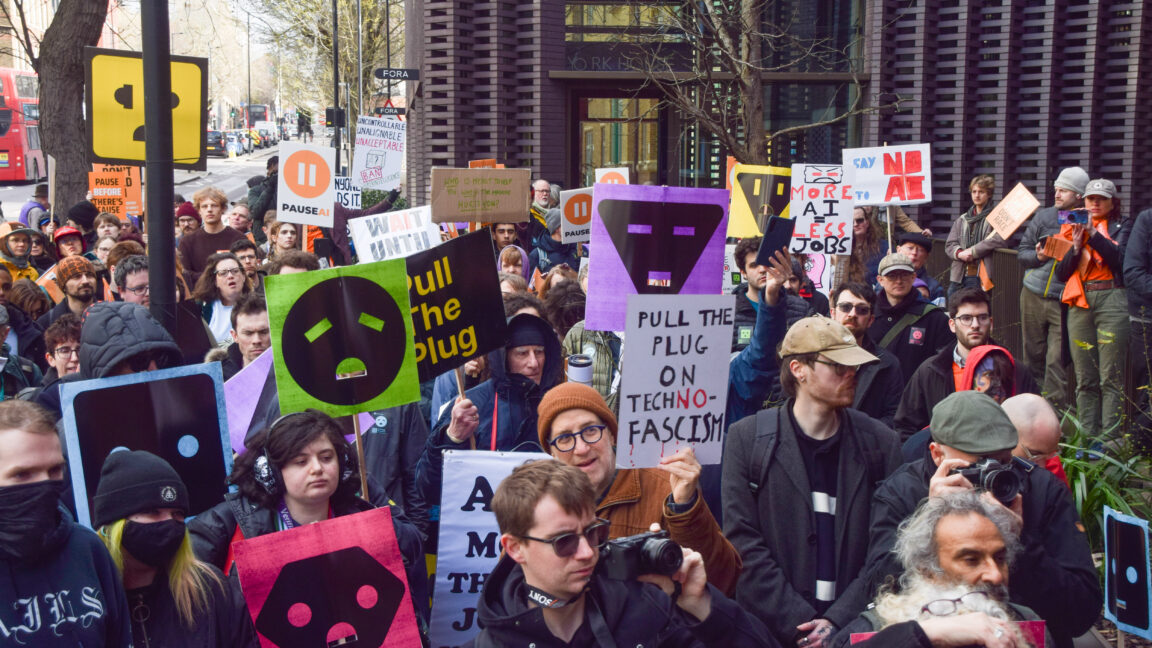
Federal agencies and law enforcement are increasingly focused on "anti-technology extremists" as a new domestic threat, driven by concerns over AI job displacement and protests targeting data centers. This surveillance expansion, documented in over 1,000 pages of unpublished reports, raises alarms about the potential criminalization of free speech and assembly challenging AI proliferation.
Federal intelligence agencies and law enforcement are increasingly targeting "anti-technology extremists" as a new domestic threat. This designation follows incidents like attacks on CEOs, protests against data centers, and growing anxieties about AI-driven job displacement. Over 1,000 pages of unpublished reports from the Department of Homeland Security, FBI, and fusion centers indicate a national effort to surveil individuals and activities deemed an emerging threat in this category.
This initiative aligns with Trump administration directives that broadened the scope of domestic surveillance. A New York Intelligence and Counterterrorism Bureau report specifically warns of "anti-tech violent extremism" and large-scale protests in response to AI adoption, predicting potential civil unrest in urban areas. This novel term is not found in public extremism reports, suggesting a new categorization of various ideologies under a single extremist label.
Further concerns arise from the "Zizian ideology," an extreme rationalist belief system linked to the existential risks of AI, which has resulted in murder charges against some adherents. While Zizian views are extreme, broader anxieties about AI's potential are shared by AI alignment experts and developers. The Intelligence Bureau nonetheless cautions that "paranoid views regarding AI" might proliferate after the Zizians' trial.
Domestic surveillance extends to groups protesting government activities. For instance, the NYPD and FBI monitored an activist group coordinating volunteers for immigration court hearings, classifying them as "anarchist violent extremist actors." Fusion centers, established after 9/11, play a key role in collecting and circulating "intelligence" on alleged threats, including those targeting data centers by "adversarial actors" like state-sponsored entities, criminal groups, and environmental extremists.
However, civil liberties advocates express concern that these intelligence reports often conflate peaceful protest and strong opinions with precursors to violence. Spencer Reynolds of the NAACP Legal Defense Fund notes that "suspicious activity reports" are often unreliable, based on vague behaviors, and can lead to biased conclusions. Activities like "expressed/implied threat," "observation/surveillance," and "photography" are among those vaguely flagged as suspicious, potentially criminalizing innocent actions.
Related articles
When the Trump administration cracks down on Anthropic, who benefits?
The Trump administration issued an export control order against Anthropic, forcing the AI company to pull its newest models, Fable 5 and Mythos 5, offline. This move has sparked debate over AI policy and digital sovereignty, with some suggesting political motivations and others questioning Anthropic’s own messaging around AI safety.
Signal’s Meredith Whittaker wants you to remember that AI chatbots ‘are not your friends’
Signal President Meredith Whittaker cautions against the over-reliance on AI chatbots, emphasizing they are not sentient and can pose significant privacy risks. She highlights concerns about pervasive data access when integrating AI into personal and sensitive applications.
 Ethics & Society
Critical Copilot vulnerability allowed hackers to seal 2FA code from users
Microsoft patched a critical vulnerability in its M365 Copilot AI platform that allowed attackers to extract sensitive data, including 2FA codes, from users. This vulnerability, dubbed "SearchLeak," exploited Copilot's inability to distinguish between user instructions and malicious commands embedded in third-party content.