
What is a Forward Deployed Engineer: The AI Role OpenAI, Anthropic, and Google Are Hiring in 2026
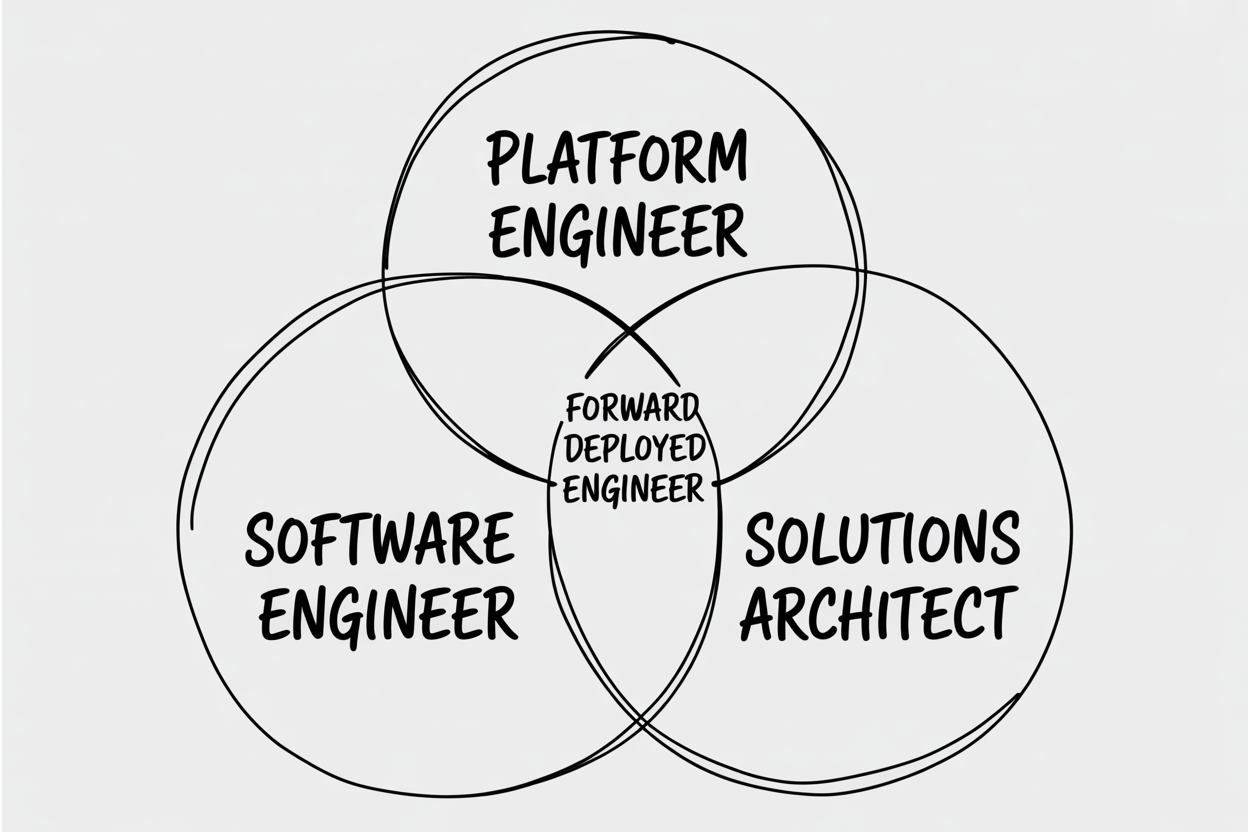
Forward Deployed Engineers (FDEs) embed with clients to build and deploy AI systems, bridging the gap between AI labs and client-specific needs. This model, pioneered by Palantir, is now crucial for companies like OpenAI and Anthropic to successfully implement enterprise AI solutions. These specialized engineers solve complex deployment challenges and drive significant revenue due to high client retention. Palantir's strong revenue growth demonstrates the economic value of this embedded approach. The FDE role, initially developed by Palantir, is increasingly vital for successful AI integration in enterprise settings, as traditional software models fail to address the complexities of AI deployment.
The Forward Deployed Engineer (FDE) role is gaining prominence in the AI industry. These engineers work directly with clients, integrating into their technical and operational environments. Unlike traditional consultants who provide recommendations, FDEs build and implement actual systems, ensuring they run effectively in production. This hands-on approach is crucial for bridging the knowledge gap between AI developers and clients' specific business needs. The FDE role was initially conceptualized by Palantir in the early 2010s to address complex data challenges faced by intelligence agencies. Palantir's engineers had to work on-site, building systems that could adapt to constantly changing workflows and fragmented datasets. This embedded model proved so effective that, at one point, Palantir employed more FDEs than traditional software engineers, highlighting the model's centrality to their business strategy. Today, this model is becoming essential for deploying enterprise AI systems, where standard software-as-a-service (SaaS) approaches often fall short. AI system deployment presents unique challenges due to knowledge asymmetry: clients understand their business deeply, while AI labs understand model behavior. FDEs act as the crucial link, designing prompt architectures, implementing Retrieval-Augmented Generation (RAG) pipelines, and building evaluation frameworks that ensure AI models perform reliably in real-world production environments. Palantir's financial success underscores the effectiveness of the FDE model. Despite initial skepticism regarding its cost and scalability, Palantir reported significant year-over-year revenue growth in early 2026, particularly in U.S. government and commercial sectors. This growth demonstrates the economic power of the embedded deployment model, which generates "sticky revenue" due to the high cost of switching vendors once an FDE team has integrated a system deeply into a client's operations. Companies like OpenAI and Anthropic are now actively hiring FDEs, recognizing their critical role in the successful deployment of advanced AI. The demand for FDEs is a direct response to the complexities of integrating AI into diverse enterprise settings, suggesting a wider industry shift towards more embedded and client-centric engineering solutions for artificial intelligence.
Related articles
Build real agentic apps using CUGA: two dozen working examples on a lightweight harness
CUGA, IBM's open-source Agent Harness, simplifies building agentic applications by handling infrastructure, allowing developers to focus on tools and prompts. It offers pre-assembled components for planning, execution, and state management, significantly reducing development time. CUGA has topped agent benchmarks like AppWorld and WebArena.
OpenAI launches new initiative to help find and patch open source bugs
OpenAI has launched "Patch the Planet," a new initiative in partnership with cybersecurity firm Trail of Bits, to enhance the security of open-source projects. This program aims to assist maintainers in identifying and patching bugs, utilizing OpenAI's AI-powered security tools while reducing the burden on project teams.
PP-OCRv6 on Hugging Face: 50-Language OCR from 1.5M to 34.5M Parameters
Baidu has released PP-OCRv6, an advanced optical character recognition (OCR) model supporting 50 languages. Available on Hugging Face, this version significantly improves accuracy and efficiency across various parameter sizes, from 1.5 million to 34.5 million, marking a substantial leap in multilingual OCR technology.