AI coding agents taught robots how to install GPUs and cut zip ties
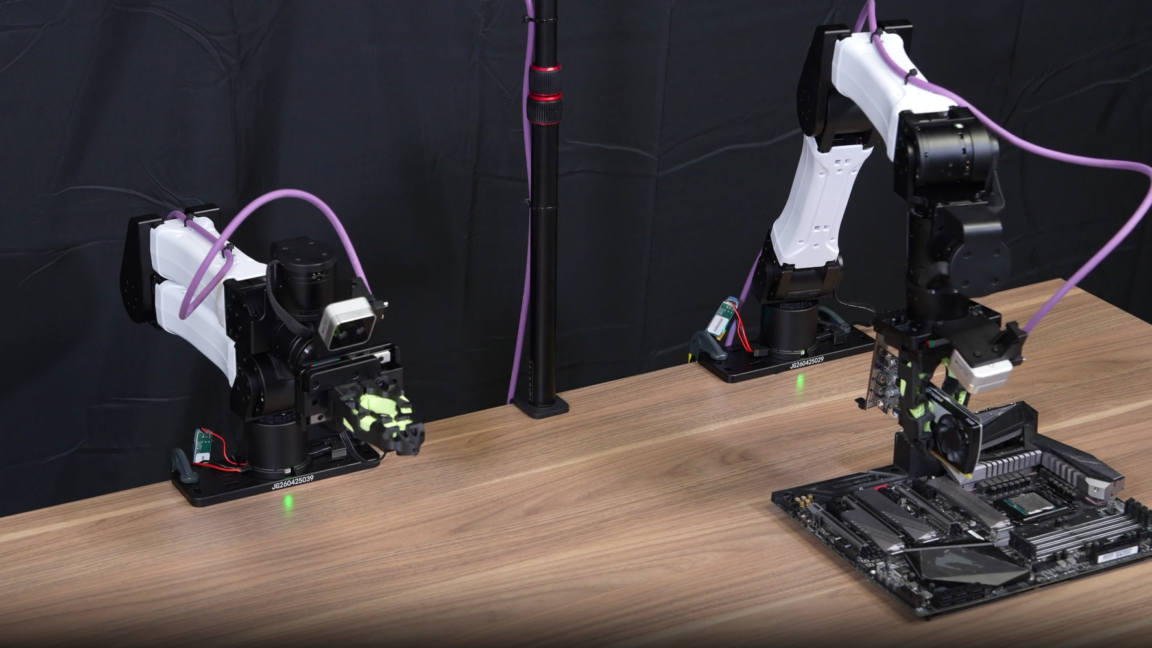
Nvidia researchers have developed ENPIRE, an AI agent harness framework, that allows AI coding agents to autonomously train robots. These agents have successfully taught robots complex tasks like inserting GPUs and cutting zip ties, achieving high success rates.
Researchers at Nvidia, in collaboration with Carnegie Mellon and UC Berkeley, have developed an AI agent harness framework called ENPIRE. This software wraps around AI models, providing them with memory, context, constraints, and feedback loops, enabling AI coding agents to autonomously train robots. The ENPIRE framework has shown remarkable success in teaching robots intricate tasks without human intervention. The system has enabled robots to perform tasks such as cutting zip ties and inserting GPUs into motherboards with high accuracy. This capability highlights a significant leap in robotic automation and AI-driven training methodologies. According to Jim Fan, NVIDIA’s director of AI, a part of their lab now self-improves tirelessly overnight, with researchers only needing to review reports in the morning. The team plans to open-source the framework, making this advanced robotic training accessible to a wider community. The ENPIRE harness comprises four modules facilitating automatic reset and verification, policy refinement, parallel evaluation across multiple robots, and failure analysis and improvement. These modules work in concert to ensure continuous learning and adaptation for the robotic systems. The framework was tested with various AI coding agents, including OpenAI’s Codex with GPT-5.5, Anthropic’s Claude Code with Opus 4.7, and Moonshot AI’s Kimi Code with Kimi K2.6. These agents independently developed and tested algorithmic approaches, improving success rates through self-directed experimentation. The AI coding agents, equipped with ENPIRE, achieved a 99 percent success rate across several manipulation tasks, including the "Push-T" task and organizing pins. Notably, in pin insertion and organization, AI coding agents achieved nearly 100 percent success faster than human-in-the-loop methods. Experiments also revealed that larger teams of AI coding agents achieved higher success rates more quickly, though this came with increased token consumption. However, limitations were observed, such as robots sitting idle while agents processed information, and larger teams spending more time summarizing ideas than utilizing robots. Despite these challenges, Nvidia continues to advance its vision for physical AI, pursuing partnerships and initiatives to scale the manufacturing of AI-powered robots. This includes collaborations with companies like Unitree and discussions with Hyundai Motor Group, aiming to integrate AI robotics into various industries.
Related articles
The AI world is getting ‘loopy’
AI models are taking a significant leap forward with the adoption of "agentic loops," where AI agents continuously prompt each other to improve code and solve complex problems. This approach, though potentially resource-intensive, promises to unlock new levels of autonomous problem-solving and efficiency in AI applications.
Codex-maxxing for long-running work
Codex is increasingly being used by organizations to support long-running projects that go beyond a single prompt. This whitepaper by Jason Liu offers practical strategies for leveraging Codex as a persistent workspace, managing complex workflows and sustaining progress.
Nobel laureate John Jumper is leaving DeepMind for rival Anthropic
Nobel laureate John Jumper is departing Google DeepMind to join its competitor, Anthropic, after dedicating nearly nine years to DeepMind, where he led the AlphaFold team. Jumper, who shared a Nobel Prize for his work on AlphaFold, expressed gratitude for his time at DeepMind while looking forward to new endeavors.