
Ukraine's one-time test used fully autonomous drones to kill Russian soldiers
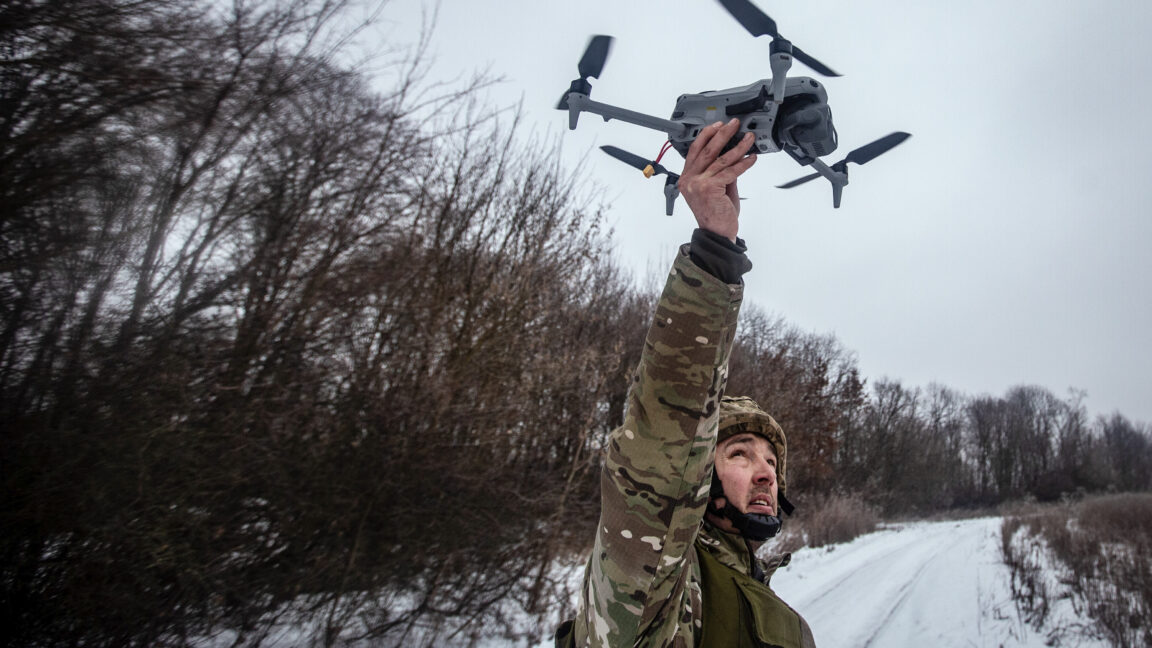
A Ukrainian drone maker claims fully autonomous drones killed Russian soldiers in a 2022 test, marking a potential new phase in AI-powered warfare. This comes as both sides increasingly deploy advanced drones with varying degrees of autonomy, though official Ukrainian policy prohibits AI in final targeting decisions.
A Ukrainian drone manufacturer claims that fully autonomous drones killed Russian soldiers in a battlefield test two years ago. This alleged incident, if true, would represent a significant escalation in the use of AI-guided weaponry within the ongoing conflict. The test involved quadcopter drones preprogrammed to fly to a front-line area and activate an AI-powered "Terminator mode" to seek and attack targets. Human-piloted drones later found "a couple" of dead Russian soldiers, leading to the conclusion that the autonomous drones were responsible. However, representatives at the Ukrainian embassy event stated that the Ukrainian government prohibits the use of AI in the final stages of target interception. A Ukrainian military commander also affirmed that their drone pilots only use semi-autonomous systems where humans retain crucial control. This adherence to international humanitarian law aims to prevent civilian casualties. The one-time nature of this experiment highlights the practical limitations and ethical considerations of fully autonomous attacks. Such systems risk "friendly fire" incidents or attacks on non-combatants due to the lack of human intervention. The overall effectiveness of these fully autonomous quadcopters in target selection compared to human pilots also remains unclear. While fully autonomous weapons capable of independent operation in complex environments are not yet widespread in Ukraine, many drones incorporate autonomous features for navigation and sometimes targeting, with human operators maintaining overall control. Both Ukraine and Russia are extensively using FPV drones for scouting and striking, as well as larger "bomber" drones for supply or explosive delivery. Longer-range strike drones may have more autonomous decision-making capabilities. Russia, for instance, uses Shahed drones, some variants of which possess advanced autonomous target recognition and retargeting thanks to smuggled microcomputers. In response, Ukraine has deployed air defense systems, including interceptor drones designed for autonomous flight and target locking, though human operators still initiate strikes. Ukraine's defense industry prioritizes training small AI models on limited datasets to run on inexpensive chips, leading to improved drone strike success rates. The Ukrainian Ministry of Defense reports over 5,000 drone strikes against Russian targets monthly, often relying on autonomous navigation due to Russian electronic warfare and GPS jamming. This AI-driven navigation has significantly boosted success rates from around 10-20% to 70-80%.
Related articles
The AI world is getting ‘loopy’
AI models are taking a significant leap forward with the adoption of "agentic loops," where AI agents continuously prompt each other to improve code and solve complex problems. This approach, though potentially resource-intensive, promises to unlock new levels of autonomous problem-solving and efficiency in AI applications.
Codex-maxxing for long-running work
Codex is increasingly being used by organizations to support long-running projects that go beyond a single prompt. This whitepaper by Jason Liu offers practical strategies for leveraging Codex as a persistent workspace, managing complex workflows and sustaining progress.
Nobel laureate John Jumper is leaving DeepMind for rival Anthropic
Nobel laureate John Jumper is departing Google DeepMind to join its competitor, Anthropic, after dedicating nearly nine years to DeepMind, where he led the AlphaFold team. Jumper, who shared a Nobel Prize for his work on AlphaFold, expressed gratitude for his time at DeepMind while looking forward to new endeavors.