
AI News category
AI Research
Curated reporting and analysis from leading sources, available in English and Arabic.
The AI world is getting ‘loopy’
AI models are taking a significant leap forward with the adoption of "agentic loops," where AI agents continuously prompt each other to improve code and solve complex problems. This approach, though potentially resource-intensive, promises to unlock new levels of autonomous problem-solving and efficiency in AI applications.
Codex-maxxing for long-running work
Codex is increasingly being used by organizations to support long-running projects that go beyond a single prompt. This whitepaper by Jason Liu offers practical strategies for leveraging Codex as a persistent workspace, managing complex workflows and sustaining progress.
Nobel laureate John Jumper is leaving DeepMind for rival Anthropic
Nobel laureate John Jumper is departing Google DeepMind to join its competitor, Anthropic, after dedicating nearly nine years to DeepMind, where he led the AlphaFold team. Jumper, who shared a Nobel Prize for his work on AlphaFold, expressed gratitude for his time at DeepMind while looking forward to new endeavors.
Diffusion Language Models: An Experimental Analysis
Research published on arXiv explores Diffusion Language Models through an experimental analysis. This paper, authored by Thomas Bertolani and a team, delves into the technical aspects of these models.
Hidden Anchors in Multi-Agent LLM Deliberation
A new paper explores "hidden anchors" in multi-agent LLM deliberation, focusing on how these models arrive at conclusions through complex interactions. This research delves into the internal mechanisms of large language models when engaged in collaborative decision-making processes.
A startup claims it broke through a bottleneck that’s holding back LLMs
A new AI startup, Subquadratic, claims to have overcome a decade-long mathematical bottleneck in large language models with its new SubQ model. Independent evaluations suggest SubQ is faster, cheaper, uses less energy, and processes significantly more text than other models, potentially revolutionizing LLM architecture.
Exposing the Unsaid: Visualizing Hidden LLM Bias through Stochastic Path Aggregation
Researchers have developed a new method called Stochastic Path Aggregation (SPA) to visualize and identify hidden biases within Large Language Models (LLMs). This technique helps to expose the "unsaid" biases that LLMs may exhibit, offering a clearer understanding of their internal workings. The paper, "Exposing the Unsaid: Visualizing Hidden LLM Bias through Stochastic Path Aggregation," provides a novel approach to addressing fairness and transparency in AI. This research aims to make LLMs more interpretable and reliable by bringing to light their embedded biases.
DeXposure-Claw: An Agentic System for DeFi Risk Supervision
DeXposure-Claw is an agentic system designed for risk supervision within the Decentralized Finance (DeFi) ecosystem. This research paper, authored by Aijie Shu and a team of collaborators, explores its functionalities and implications.
MosaicLeaks: Can your research agent keep a secret?
Research agents combining private documents with web tools risk leaking sensitive information through external queries. MosaicLeaks introduces a task to measure this "mosaic effect" leakage across three levels: intent, answer, and full-information. Training only for task performance worsens leakage, while a new privacy-aware training method significantly reduces it while improving accuracy.
Using AI to help physicians diagnose rare genetic diseases affecting children
A new study demonstrates how AI can aid in diagnosing rare genetic diseases in children. By reanalyzing previously unsolved cases, an OpenAI reasoning model helped identify 18 new diagnoses, showcasing the potential of AI-assisted research workflows.
Beyond LoRA: Can you beat the most popular fine-tuning technique?
This article explores recent advancements in large language model (LLM) fine-tuning techniques, specifically focusing on alternatives to the widely-used LoRA method. It delves into new research that aims to surpass LoRA's efficiency and performance by introducing innovative approaches to adapt pre-trained models for specific tasks.
 Research & Papers
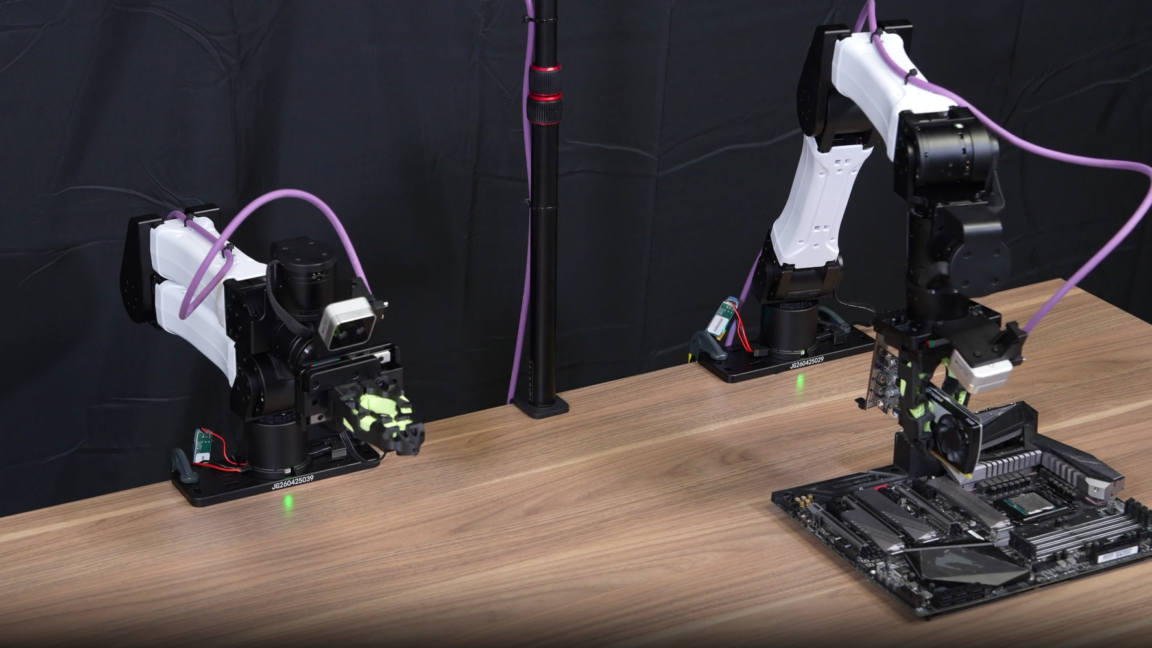
AI coding agents taught robots how to install GPUs and cut zip ties
Nvidia researchers have developed ENPIRE, an AI agent harness framework, that allows AI coding agents to autonomously train robots. These agents have successfully taught robots complex tasks like inserting GPUs and cutting zip ties, achieving high success rates.
 Research & Papers
"Dangerous" AI models are coming no matter what
Anthropic recently took its Claude Fable 5 and Mythos 5 AI models offline due to a US government export-control directive. This move highlights a broader challenge: advanced AI capabilities are becoming widespread, raising concerns about national security and the dual-use nature of these powerful tools.